

Lithium 12-hydroxystearate (CAS 7620-77-1) is a lithium soap used to thicken lubricating oils into grease. Its fibrous structure helps retain base oil and gives the finished grease its consistency. In automotive and industrial formulations, this structure contributes to oil release, mechanical stability and retention at the lubrication point. Base oil, additives and manufacturing conditions remain equally important to the finished performance.
The material is the lithium salt of 12-hydroxystearic acid, rather than the fatty acid itself. Its formula is C18H35LiO3, with a molecular weight of approximately 306.41 g/mol. Commercial industrial material is commonly supplied as white or off-white powder. A preformed soap grade and a soap formed in the grease kettle require different charging and processing conditions, even when the intended thickener chemistry is the same.
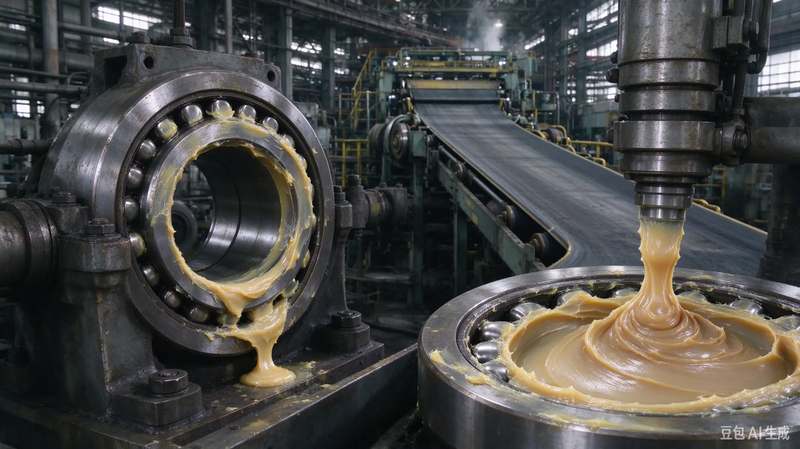
Why Lithium 12-Hydroxystearate Works as a Grease Thickener
Fiber Formation and Oil Retention
During grease manufacture, soap molecules assemble into fibers and a connected network within the oil. That network holds the liquid phase while allowing oil to reach the lubricated surfaces. Its structure develops through the formulation and thermal history, including reaction, dehydration, heating, cooling and finishing. A smooth appearance alone does not reveal the fiber arrangement or establish how the grease will behave after prolonged working.
A study of excess thickener components examined lithium greases made with different ratios of 12-hydroxystearic acid and lithium hydroxide monohydrate. In that experimental system, excess lithium hydroxide and a 10% excess of the acid changed fiber structure and improved selected consistency, colloidal-stability and structural-strength results. A larger acid excess produced a different structure. These findings support controlling the acid/base balance, rather than treating any excess as a general formulation recommendation. Read the microstructure study.
Dropping Point and Operating Temperature
Simple lithium greases can combine useful mechanical stability with water resistance, but their thermal limits depend on the complete formulation. Dropping point measures a particular change in grease behavior under a specified test. It is not the continuous operating temperature, and it is not interchangeable with the melting behavior of the isolated soap powder.
Published finished-grease data illustrate the distinction. The following examples describe specific commercial products, not guaranteed results from a raw-material grade of lithium 12-hydroxystearate.
| Published grease example | Thickener type | Dropping point | Operating range |
|---|---|---|---|
| SKF LGMT 2 | Lithium soap | >180 °C | −30 to +120 °C |
| SKF LGWA 2 | Lithium complex | 250 °C minimum | −30 to +140 °C |
Simple Lithium Soap and Lithium Complex Grease
A simple lithium soap system and a lithium complex system are different formulation platforms. A lithium complex thickener combines a simple soap such as lithium 12-hydroxystearate with an additional complexing component. Shorter-chain difunctional acids, boric acid or aromatic acids can be involved, depending on the chemistry. NLGI describes these thickener families.
Complex systems are often selected when a higher dropping point or a different performance balance is needed. That does not make every complex grease suitable for every high-temperature or heavy-load duty. Base-oil oxidation, oil release, pumpability, additives and bearing conditions still matter. Mixing existing and replacement greases also requires a compatibility assessment; a shared lithium label is not sufficient evidence.
Automotive Wheel Bearing and Chassis Greases
The Finished Grease Specification
ASTM D4950 addresses service-fill greases for periodic relubrication of vehicle chassis systems and wheel bearings. Its chassis categories include LA and LB, while wheel-bearing categories include GA, GB and GC. GC-LB identifies the combined higher wheel-bearing and chassis performance categories. The designation concerns the tested finished lubricant, not the identity of its soap raw material.
The qualification framework covers more than a dropping-point result. Relevant performance areas include consistency, wear, extreme-pressure behavior, rust protection, water washout, oil separation, leakage, high-temperature life, fretting, elastomer compatibility and low-temperature torque. In its current GC-LB and HPM comparison, NLGI lists a GC-LB minimum dropping point of 220 °C. A general-purpose grease reporting a lower dropping-point specification cannot establish GC-LB compliance from that value alone.
NLGI also maintains the High-Performance Multiuse (HPM) certification, adopted in 2020, alongside GC-LB. HPM combines core requirements with optional water-resistance (+WR), corrosion-resistance (+CR), low-temperature (+LT) and high-load (+HL) enhancements. These are finished-grease certification options; adding lithium 12-hydroxystearate does not confer certification.
What the Soap Network Contributes
In a wheel bearing, the grease must retain enough oil at the contact while controlling leakage and resisting structural change. A soap network that changes substantially under working can alter consistency and oil separation. The thickener therefore contributes to several test outcomes, but oxidation resistance and load-carrying performance also depend on the base oil and additive system.
For an NLGI 2 grease, the worked penetration range is 265–295 in units of 0.1 mm at 25 °C. This is a consistency classification, not a complete quality rating. Water washout and corrosion results likewise belong to a defined finished formulation and test method. A rust rating cannot substitute for a washout percentage, and neither can be assigned to an untested soap powder.
Electric Vehicles and Low-Torque Applications
Electric vehicles retain wheel bearings, joints and other grease-lubricated components while adding demanding electric-motor bearing duties. NLGI technical discussion of EV lubrication identifies efficiency, noise and bearing requirements as relevant development issues. Fine dispersion and batch consistency can support formulation control, but lithium soap identity alone does not establish low torque, quiet running, electrical behavior or long life. These require testing in the intended assembly.
Industrial, Heavy-Duty and Specialty Applications
Motors, Conveyors and Heavy Machinery
Lithium soap greases are used in general industrial bearing applications, including motors, fans, pumps and conveyors. Construction, agricultural and mining equipment add shock loading, vibration, contamination and water exposure. The thickener helps maintain grease structure, while an appropriate oil viscosity and additive package support the contact conditions.
A published industrial example is SKF LGEP 2, a lithium-soap EP grease with a mineral base-oil viscosity of 200 mm²/s at 40 °C. Its listed applications include heavy machinery, vibrating screens and work-roll bearings. This is a formulation example, rather than a universal oil-viscosity requirement or proof that every lithium soap grade has equivalent EP performance. SKF technical catalogue.
Wind-energy and rail applications can add cold-start, long-interval and mechanical-stability requirements. Lithium-containing formulations may be evaluated for these duties, but the equipment specification determines whether a particular simple lithium, lithium complex or alternative grease is appropriate. Gearboxes designed for fluid oil also should not be treated as general grease applications.
Food-Processing and Other Specialty Lubricants
For food-processing equipment, industrial grease suitability is separate from incidental-food-contact lubricant status. NSF registration and ISO 21469 certification consider formulation, intended use and other defined requirements. A thickener used in a research formulation does not by itself make a commercial grease food grade. Ingredient eligibility, the complete recipe and the finished lubricant documentation need to match the intended use.
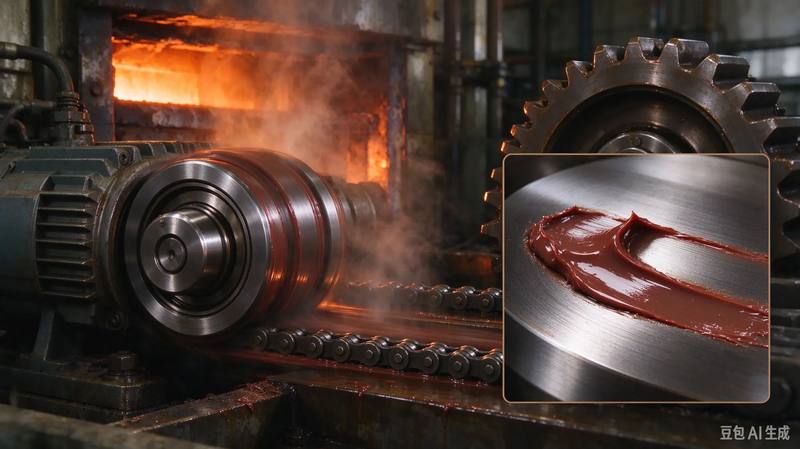
Raw Material Parameters That Affect Grease Production
A useful soap specification connects measurable raw-material properties with processing behavior. Matching a single assay or lithium value does not guarantee identical grease structure. The following parameters provide a more complete basis for comparing lots and evaluating a supplier change.
| Parameter | Relevance to the grease formulation |
|---|---|
| Lithium content | Helps assess composition and acid/base balance. The theoretical lithium mass fraction for pure C18H35LiO3 is about 2.26%; an agreed commercial specification must account for the actual grade and method. |
| Free fatty acid and residual alkalinity | Influence reaction balance and the structure developed during processing. Either an acid or alkali deviation can change the finished result. |
| Moisture or loss on drying | Affects charging, dehydration and the reproducibility of the thermal process. |
| Fineness and particle-size distribution | Influence powder incorporation, dispersion and the risk of coarse particles in the finished grease. |
| Colour and odour | Matter for appearance requirements and may help identify a change in raw material or processing history. |
| Thermal and crystallization behavior | Help assess how a soap grade fits the manufacturing cycle; test method and conditions should be stated. |
| Batch traceability | Links material identity and test results to production records when investigating a change in grease performance. |
Two lots can show similar elemental composition while differing in precursor distribution, particle form or processing history. A controlled comparison in the intended formulation can therefore include worked penetration, oil separation, dropping point and the application-specific performance tests. The same base oil, additive levels and manufacturing procedure are needed for a meaningful comparison.
Lithium 12-hydroxystearate can be prepared by neutralizing 12-hydroxystearic acid with lithium hydroxide. A preformed powder is incorporated differently from soap generated in situ. Drying route, moisture, milling and charging behavior should be identified for the supplied grade rather than assuming that all commercial soap is spray dried. The acid precursor may be obtained from hydrogenated castor-oil feedstock, with its source and composition affecting the manufacturing context.
Sourcing, Sustainability and Safe Handling
Castor-derived 12-hydroxystearic acid is commercially available, as illustrated by castor-based 12-HSA product information. Renewable carbon in an acid precursor can be relevant to sourcing, but it does not demonstrate a verified bio-based percentage for a supplied lithium soap or establish the biodegradability of a finished grease. The base oil and additives must also be considered.
Environmental claims need substance- or formulation-specific evidence and the relevant test method. A category-level statement about fatty-acid salts should not be transferred directly into a claim that a commercial grease is readily biodegradable, non-toxic or suitable for unrestricted release.
Powder handling should follow the current Safety Data Sheet for the supplied grade. Charging arrangements should control dust and use suitable ventilation and personal protection, with ignition controls where the SDS identifies combustible-dust concerns. Closed, dry storage and protection from contamination help maintain the material condition. Chemical-inventory status and application documents should be checked for the destination market; this article does not establish a supplier-specific registration or approval.
Frequently Asked Questions
Can lithium 12-hydroxystearate replace a lithium complex thickener?
It can provide the simple-soap component of a complex system, but a one-for-one substitution does not reproduce the complex thickener. The complexing chemistry and process are part of the formulation. Where a specification requires higher-temperature or other complex-grease performance, the complete grease must be reformulated and validated rather than relying on a fixed temperature difference between thickener families.
Why can grease soften after a supplier change despite a similar assay?
Assay does not describe the full structure-forming behavior of a grade. Residual acid or alkalinity, moisture, powder dispersion, precursor composition and the thermal cycle can all influence the result. A comparison of raw-material data together with controlled grease trials is more informative than treating the matching assay as proof of equivalence.
Is this lithium soap suitable for EV-related grease development?
It can be evaluated for a lithium-soap formulation intended for an EV-related component. Suitability remains specific to the bearing or assembly. Torque, noise, materials compatibility, electrical requirements and durability belong to the finished grease and component validation; they cannot be inferred solely from CAS 7620-77-1.
How does a lithium soap grease behave in wet conditions?
Many lithium soap greases provide useful water resistance, but exposure to water can still change consistency, retention and corrosion behavior. Washout-critical duty requires results from the defined grease formulation and relevant test conditions. The soap network, base oil, additives and sealing arrangements contribute together.
Conclusion
Lithium 12-hydroxystearate is an established grease thickener because the structure it forms helps control oil retention and consistency. Reliable automotive and industrial performance depends on how that structure develops alongside the base oil and additives. For raw-material selection, composition, residual acid/base balance, moisture, fineness and batch traceability provide a stronger basis than a single purity figure.
For lithium 12-hydroxystearate powder specifications, available quality documents and supply enquiries, contact Unilong Industry Co., Ltd..
Post time: Nov-24-2026